How to Check a Contractor's Trade License in Dubai (Free DED Check)
·
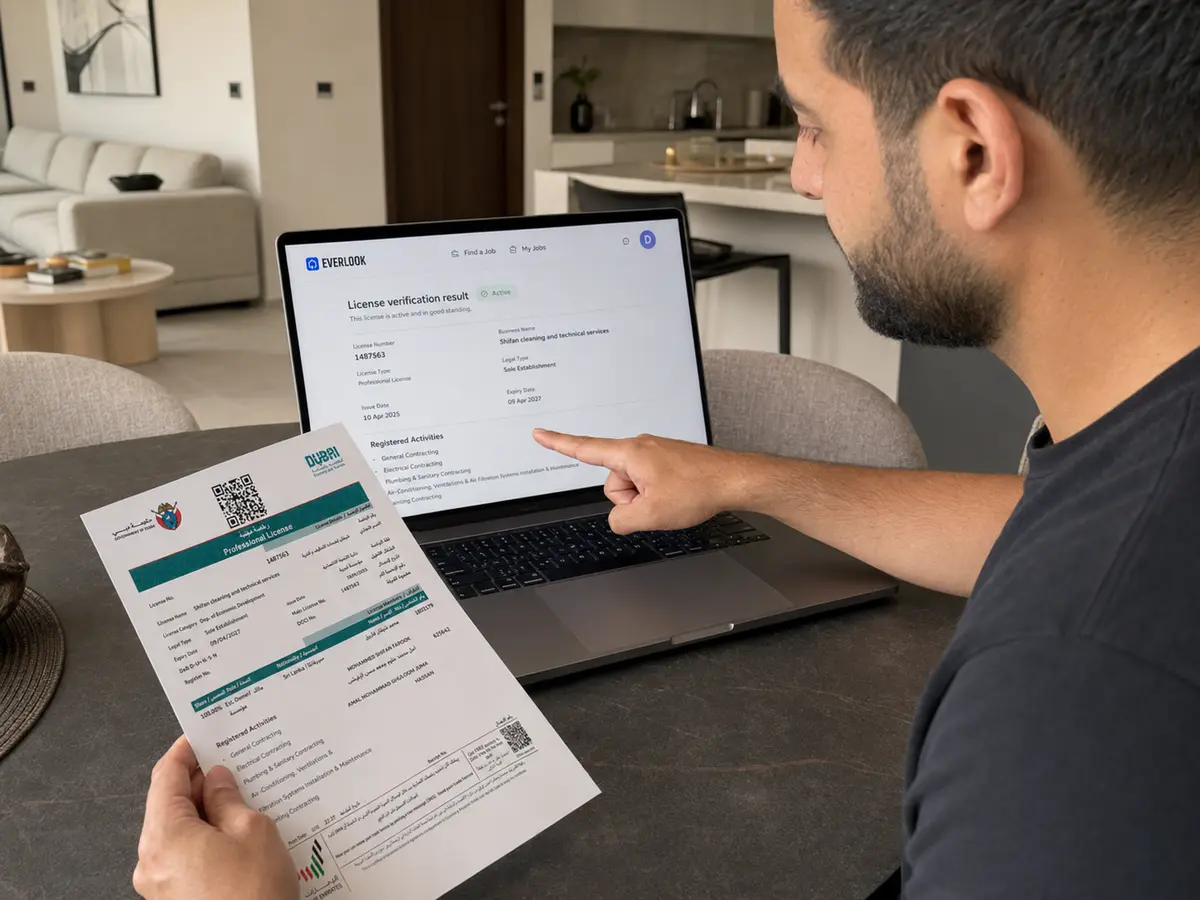
How to run a free DED licence check
Before a plumber, electrician or AC technician sets foot in your Dubai flat, you can confirm whether their company is licensed to do that work. A DED licence check is that confirmation, it takes about a minute, and it costs nothing.
DED stands for the Department of Economic Development, the Dubai authority since renamed the Department of Economy and Tourism (DET), though almost everyone, contractors included, still says DED. It issues the trade licence every mainland Dubai business must hold, and the register of those licences is public.
Two official routes exist. The UAE government platform lets anyone inquire about licences, trade names and activities across the emirates, and the mainland Dubai records themselves are published on Dubai's open-data platform, whose licence master dataset is the primary reference for mainland businesses and the activities each one performs.
Both are built for people who handle licence data all day. For a one-off hire, Everlook runs a free public tool, the Everlook's free licence-check tool, over that same official Dubai DED data. No account, no signup, no permission from the contractor: type in what you have and read the result.
Search by licence number or by trade name
If the contractor has sent a quote, an invoice or a licence copy, the licence number is printed on it. Type that in for an exact match.
If all you have is a company name, search by trade name instead and pick the matching record. Trade names are the awkward part: the registered name is usually longer and more formal than the one on the van or the WhatsApp profile — "Al Something Technical Services LLC" rather than "Al Something AC". Search the distinctive word, not the whole string.
Either route returns the same core facts: the current status, the expiry date, the licence category, and the full list of registered activities. That last field is where the real answer usually sits.
Reading the result: status, expiry and activities
A licence is not just a number on a wall. The record carries the company's registered trade name, its licence number, the issuing authority, the issue and expiry dates, the current status, and the activities the business is permitted to perform.
Three of those fields decide whether the contractor in front of you is a safe hire.
The status field
Status is the fastest read. Active means the licence is current and the business is authorised to trade. Any other value means it is not current, whatever the letterhead says. Expired is the one you are most likely to meet.
Treat a non-active status as a pause rather than a verdict on character. Renewals lapse for dull administrative reasons all the time. But the pause belongs before the work starts, because a company trading on a lapsed licence leaves you very little to stand on if the job goes wrong.
The expiry date
Check the expiry even when the status reads active, and check it against your job's timeline rather than against today. A licence expiring in nine days is fine for a same-day tap replacement and a poor bet for a bathroom refit that runs three weeks.
Mainland licences typically renew on an annual cycle, so an expiry date a few weeks out is routine rather than alarming. It still earns one question: is the renewal already in hand.
Activities are the field that actually decides it
Registered activities are the specific lines of work the licence authorises, worded in official terms: "Electrical Fitting Contracting", "Plumbing and Sanitary Installation", "Air-Conditioning Systems Installation and Maintenance". A business may legally perform what is on that list and nothing beyond it.
This is where mismatches surface, and they are quieter than an expired date. A licence valid for general trading does not cover electrical work. A cleaning and general-maintenance licence does not cover rewiring a socket or moving a distribution board. The paperwork is real, current, and irrelevant to the job you are about to book.
So read the list against the actual scope of the work, and read it in the officialese it is written in: "sanitary installation" is plumbing, "fitting contracting" is installation rather than retail supply. A single technical-services licence often carries several related activities at once, which is normal and usually a good sign for multi-trade jobs.
One note on the document itself, since it confuses new residents. Dubai's own portals and the printed certificate use the American spelling, "Trade License". A licence copy that reads License rather than Licence is not a forgery tell.
Mainland, free zone, or another emirate
There is a limit worth knowing before you rely on the result: a Dubai DED check only covers mainland Dubai companies. It is not a national register.
Free-zone companies are licensed by their own free-zone authority (DMCC, JAFZA, Dubai Silicon Oasis, or Trakhees for the port and free-zone areas it regulates), not by DET. They will not appear in mainland DED data even though they are perfectly legitimate. So a "not found" result does not automatically mean "unlicensed".
The other emirates run their own economic departments. Abu Dhabi mainland firms are licensed by the Abu Dhabi Department of Economic Development (ADDED); the Northern Emirates have their own registries. A Sharjah-registered firm will not show up in a Dubai search.
There are also freelance permits: person-centric licences for independent professionals, issued by the Dubai and Abu Dhabi economic departments rather than tied to a company trade name. A solo handyman may be working on one of those.
So the right mental model is simple. A Dubai DED check confirms a Dubai mainland licence. If nothing comes up, the next question is not "are they a fraud" — it is "which authority licensed you, then".
What to do with each result
You will land on one of four outcomes. Here is what each one is worth acting on.
Valid, and the activity matches
This is the baseline you want: status active, expiry in the future, and registered activities that cover the job. Treat it as a good first signal — the company is legally registered and authorised for that line of work. It is a floor, not a ceiling; keep going with reviews and a written quote.
Status shows expired
An expired licence means the company is not currently authorised to trade. Ask the contractor to confirm the renewal has gone through and to send the updated copy before you let any work start. If the answer is vague and the job involves anything you cannot easily undo, book someone else.
Activities do not match the job
The licence is valid and the trade is wrong. That is the situation that leaves you with no recourse if the work fails, because the company was never authorised to do it. Ask directly whether they hold the matching activity — plenty of firms do and simply sent the wrong licence copy — or find a contractor whose licence already covers it.
Nothing found
A blank result has three innocent explanations and one that is not. They could be free-zone licensed, registered in another emirate, or working on an individual freelance permit, all legitimate, and none of which appear in a mainland search. Or they could be unlicensed. The way to tell them apart is to ask which authority issued their licence, then verify with that authority. A straight answer is reassuring; evasion is not.
What a licence does and does not guarantee
Be clear-eyed about what you are buying with this check, because it is easy to over-read.
A valid trade licence proves one thing: the business is legally registered and authorised for the listed activities. That is genuinely useful — it filters out firms with no standing to invoice you at all.
It does not guarantee the quality of the workmanship. It does not promise that the specific worker who turns up is skilled or experienced. And it says nothing about whether the company carries insurance for accidental damage. A spotless licence and a botched repair can coexist.
So the licence check is one layer, not the whole vetting. Pair it with recent reviews, a written and itemised quote, and the broader habits covered in this guide to avoiding common hiring scams. For higher-risk work in older buildings, the same logic that drives a proper electrical inspection applies here too: paperwork first, then evidence of competence.
Keep your expectations matched to the tool. The licence answers "is this business allowed to do this." Reviews and quotes answer "will they do it well."
How Everlook takes the paperwork off you
Chasing licence numbers, decoding activity lists and cross-checking expiry dates is a lot of admin for hiring one tradesperson. On Everlook, that work is done up front.
Contractors register with their DED licence number, which ties their profile to the service categories their licence actually permits, so a firm without a plumbing activity does not surface as a plumber. Submitted licence documents are reviewed by the team before a provider is cleared to take jobs.
To be precise about what that is and is not: it is human vetting done before a contractor goes live, not automated real-time verification on every booking, and there is no public "verified" badge to look for on the site. It simply means the groundwork this article describes has largely been handled before you ever see a provider — for plumbing, AC and electrical work alike. You can still run the check yourself on any company you are considering, on or off the platform.
Frequently asked questions
What does this check actually tell you?
A DED licence check is a search of Dubai's public mainland trade-licence register for a specific company. It returns the licence status, the expiry date, the licence category and the registered activities the business is permitted to perform. It confirms that a company is legally registered in mainland Dubai and authorised for a given line of work, using official Department of Economy and Tourism data.
What does DED stand for?
The initials belong to the Department of Economic Development, the Dubai authority that licenses mainland businesses. It was renamed the Department of Economy and Tourism (DET), but the DED name stayed in everyday use, on older documents and in the open-data feeds. A DED licence and a DET trade licence are the same thing.
Does it cost anything to check?
Search the company by licence number or trade name against official Dubai DED data. Everlook's public licence-check tool does this free, with no account and no permission from the contractor. Confirm the status is active, the expiry date is in the future, and the registered activities cover the work you are hiring for. The official UAE government channels are free too.
Why can't I find a company on the DED check?
A DED check only covers mainland Dubai companies. A blank result usually means the firm is licensed in a free zone, registered in another emirate such as Abu Dhabi (ADDED) or Sharjah, or working on an individual freelance permit. Ask which authority issued their licence and verify directly with that body before assuming anything is wrong.
Is a DED licence check enough to trust a contractor?
No. A valid licence confirms the business is legally registered and authorised for those activities, and nothing more. It does not guarantee workmanship, the skill of the worker sent to your flat, or that the company is insured against accidental damage. Combine the check with recent reviews and a written, itemised quote before you commit to anything.
Booking a vetted contractor on Everlook
An unverified contractor only becomes a problem after the fact — once the socket is live, the pipe is buried behind new tiling, and the company you cannot find in any register has stopped answering. Everlook removes that gamble at the front of the job: contractors register with their DED licence number, profiles are tied to the categories that licence actually permits, and reviews from other UAE residents sit next to every quote.
Find your next pro on Everlook
Compare licensed contractors in your area in under a minute. Free to post, no signup needed to browse.
Find your next pro on Everlook
Post a job in minutes and get offers from trusted local contractors. Free to start.
Get started