Cockroaches in Dubai: Why They Keep Coming Back and How to Stop Them
·
Why there are so many cockroaches in Dubai
Cockroaches need warmth, moisture and food. A Dubai tower supplies all three without interruption, which is why the problem has no real off-season here. The reason is architectural rather than climatic — the desert outside is hostile to both species that matter, and the building is not.
Air conditioning took away the off-season
Insect development runs on temperature. Cooled interiors hold roughly 22 to 24°C in August and in January alike, so an indoor population never slows the way an outdoor one does. A German cockroach can complete its life cycle in two to three months under favourable conditions, and humid kitchens with permanently damp cabinet voids keep those conditions near-optimal all year.
The building's plumbing is one connected habitat
A tower is drilled vertically at the same points on every floor for a building riser carrying drainage, water supply and the chilled-water pipes fed by district cooling (Empower, Emicool). Those shafts are warm, dark, damp and continuous from basement to roof. A cockroach moving from the ninth floor to the eleventh never goes outside; it passes the wall penetrations of a dozen kitchens on the way.
Density, construction and how towers handle waste
Several hundred units share one refuse chute and one ground-floor bin room, a concentrated food supply sitting inside the same structure as the flats. Ground and podium floors, closest to that infrastructure, are the usual trouble spots. Movement between buildings is mostly passive: German cockroaches travel in cardboard cartons, deliveries and second-hand appliances, and fit-out work next door pushes established colonies outward along the shared services.
Does it get worse in summer?
Indoors, less than you would expect, because cooling flattens the seasonal curve for the species that lives inside. What changes through summer (Mar-Oct) is what arrives from outside: the larger drain-dwelling species pushes up from shared drains and service ducts into cooler, wetter interiors. Bathroom sightings tend to climb in the hot months, while kitchen populations are less obviously seasonal.
The two cockroach species you will actually meet in the UAE
Two species account for the overwhelming majority of UAE apartment calls. Telling them apart is worth 30 seconds, because they point at different sources and respond to different treatment.
German cockroach: small, striped, and already indoors
Adults are small, roughly 1.5 cm, light brown to tan, with two dark parallel stripes down the shield behind the head. Nymphs are darker, almost black, carrying the same stripes. You find them in cabinet voids, behind the fridge motor, in the warm gap beside a dishwasher, and around the kitchen ceiling void where pipework passes through.
This species lives entirely inside buildings and does not survive outdoors in this climate, so one sighting means a breeding population within a few metres. It is the faster breeder by a wide margin: a female produces up to five egg cases, each holding roughly 30 to 40 embryos, and carries the case until a day or two before it hatches. Daylight sightings mean the harbourage is already crowded.
American cockroach: large, reddish-brown, and coming up the drain
Three to four centimetres long, glossy reddish-brown, with a pale border around the shield behind the head. Big enough that people describe it by size before colour, and able to glide short distances, which is where most "it flew at me" stories come from.
Its habitat is wet infrastructure: floor drains, laundry areas, ground-floor bathrooms, bin rooms and sewer lines. It develops slowly, a generation often taking six to 12 months, and each egg case carries only around 14 to 16 embryos. The population is almost never inside your flat, and the U-bend trap under a rarely used floor drain is the door.
What the species tells you about the source
A small striped cockroach in a kitchen cabinet means an indoor colony, in your unit or a neighbouring one, and the fix is bait plus sealing. A large reddish-brown one crossing the bathroom at 2am means drainage. Photograph one next to a coin for scale before disposing of it, so a technician can identify the species and arrive with the right products.
Why they come back after treatment
The single biggest reason cockroaches come back is not that the product failed. It is that the population was never in your apartment in the first place. The colony lives in the wall voids, drainage stacks and common areas that connect every unit, and individuals migrate in nightly to feed.
The second reason is the egg cases. Oothecae are protected by a hardened shell that contact insecticide does not penetrate, and they hatch days after the treatment that killed the adults. So you kill 20 today, see 5 tomorrow, 20 the day after — and conclude the spray stopped working. It worked. The supply refilled.
The third reason is resistance. Peer-reviewed work on resistance management in German cockroaches notes that resistance has appeared to every insecticide class introduced for cockroach control since the early 1950s, that gel baits are not exempt, and that rotating products or using mixtures with several modes of action is the practical counter.
Why supermarket sprays usually fail
Surface sprays kill the cockroaches you can see. What they do not reach:
- The egg cases, whether carried by a female or tucked into a crevice.
- Cockroaches inside wall voids, under cabinet carcasses and in the bathroom plumbing recess.
- The breeding population in neighbouring units, which arrives through the same wall penetrations as before.
Repellent household sprays add a second problem. They scatter a colony deeper into voids and, in a shared wall, sometimes straight into the flat next door, and they contaminate the exact surfaces where bait would otherwise go.
What actually works
Gel baits inside the cabinet voids
Professional-grade fipronil or indoxacarb gel, placed as pea-sized dabs along travel routes: under the sink, behind the fridge, at pipe penetrations, inside cabinet hinges. Cockroaches feed, return to the harbourage and die there, and residues in droppings and carcasses kill others that never touched the bait. Populations typically crash within two to three weeks. Do not spray anything near a baited point; repellents undo the bait.
Sealing every pipe penetration
Look under the kitchen sink and behind the washing machine. There are almost always open gaps where pipes pass through the wall, left from installation and never closed. Fill them with silicone, or with steel wool packed behind sealant where the gap is wide, and do the same at the bathroom access panel. This step turns your unit from a corridor into a dead end, and it is the one most residents skip.
Drain treatment with an insect growth regulator
Floor drains in laundry areas and ground-floor bathrooms are the main breeding site for the larger species, and bleach poured down the opening runs straight through without reaching anything in the trap or the pipe beyond. A monthly drain product containing an insect growth regulator (IGR) stops nymphs maturing into breeding adults, so the cycle breaks instead of pausing. Running water down rarely used drains weekly keeps the water seal intact.
Coordinated treatment across the building
For a tower with chronic re-infestation, treating one flat is a losing game. Ask the building's FM (facilities management) team to schedule a coordinated treatment covering the service shafts, bin rooms, common drains and the units either side of yours. Most management companies already retain a pest contractor and will arrange this on request, particularly when several residents report the same thing in the same month.
What to expect from a professional treatment
If sealing and baiting have not held, the next step is an inspection-led treatment from a vetted pest-control contractor rather than another round of retail products.
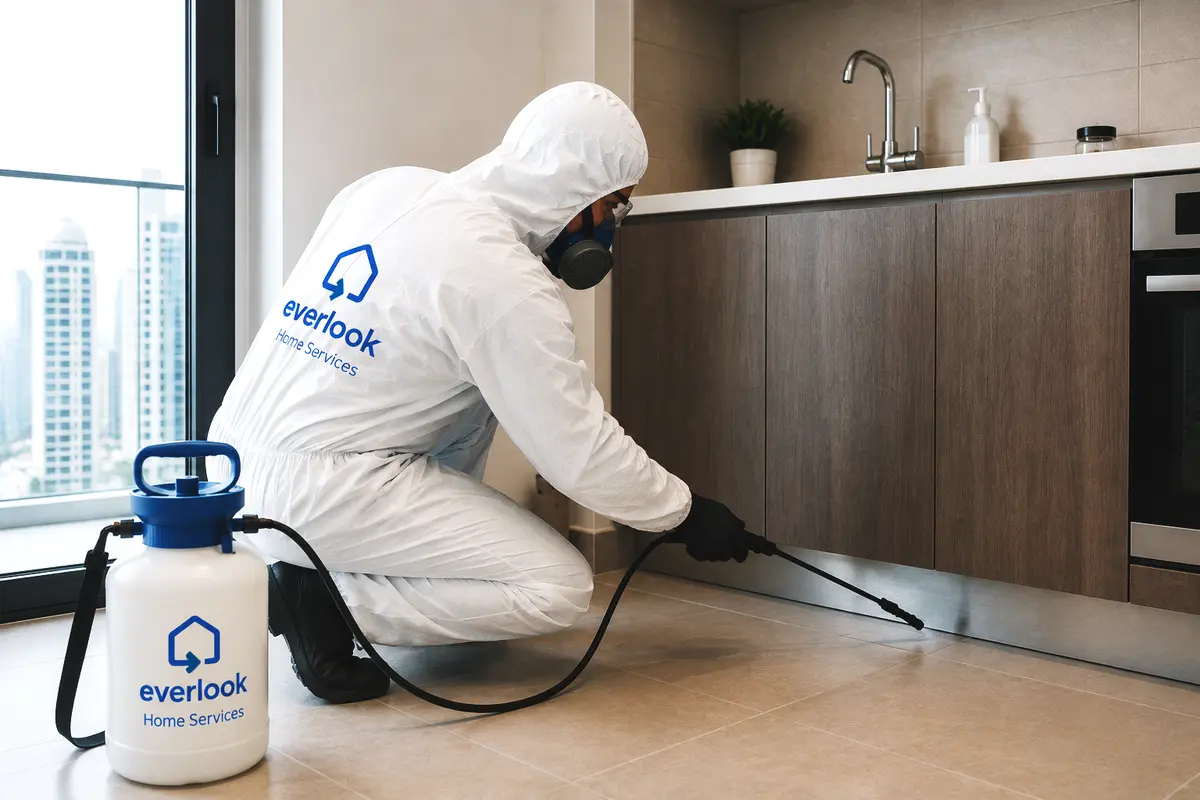
A competent visit starts with inspection. The technician should open cabinets, pull the fridge out, check pipe penetrations and the bathroom recess, and often place monitoring traps to find where activity concentrates. Someone who walks in and immediately fogs a room has skipped the step that decides whether the treatment works. The treatment itself is layered: gel bait as the primary tool in kitchens, a growth regulator to stop the next generation, a non-repellent residual product or dust worked into cracks and voids rather than across open surfaces, and drain work where the species calls for it.
Your part is to clear the cabinets that need treating and stop spraying anything for a few days beforehand. Afterwards, leave the gel dabs alone when cleaning, expect sightings to rise briefly as insects leave disturbed hiding places, and give it two to three weeks before judging the result.
Follow-up visits are not upselling. Egg cases laid before the treatment hatch after it, and the second visit exists to catch that generation before it breeds. A guarantee period works on the same logic: a defined window in which the contractor returns at no extra charge if activity continues. Read what it covers, since terms differ and some exclude building-wide sources.
On licensing there is a public check available. Pest-control companies operating in Dubai must obtain a No Objection Certificate from Dubai Municipality's Public Health Pest Control Section before they can hold a trade licence, and the section publishes a list of approved companies.
What doesn't help
- Ultrasonic repellers: no peer-reviewed evidence they affect cockroach behaviour at all.
- Bay leaves, cucumber peel, vinegar: internet folklore. Cockroaches walk over all of them without slowing.
- Fogging cans: they kill what is exposed, fail to penetrate the voids that hold the colony, and coat surfaces you then have to clean.
- Boric acid scattered loose: sound in principle, but a visible layer of powder gets walked around rather than through.
Where hygiene actually fits
A spotless kitchen reduces cockroach numbers but does not eliminate them if the building has a population. That is worth stating plainly, because tenants often read an infestation as a personal failure and delay reporting it for that reason. Three habits still change how attractive your unit is compared with the one next door:
- Wipe under-sink drips weekly. A cockroach survives on a single droplet a day, and moisture matters more than crumbs.
- Empty the kitchen bin nightly and keep the lid closed.
- Leave no standing water in the sink overnight, and store dry goods and pet food in sealed containers.
Two related problems follow the same logic in a Dubai flat: mosquitoes and ants through the summer also arrive because of water and gaps rather than dirt, and the same sealing work helps with both.
Landlord or tenant: who deals with a building-wide problem
Practice varies, so treat this as orientation rather than a rule. In most Dubai tenancies, day-to-day pest control inside the unit sits with the tenant while structural issues and common areas sit with the landlord or the owners association. What governs is your tenancy contract, registered via Ejari, so read what it says before the conversation.
The distinction that matters practically is source. If the infestation traces to common drains, refuse rooms or the pipe shafts, no individual tenant can fix it, and escalating to the building manager is the correct move rather than a courtesy. Put it in writing and note the dates you saw activity.
If a landlord is contractually responsible for a recurring problem and refuses to act, the Rental Disputes Centre (RDC) in Dubai handles tenancy disputes. That is a last step, not a first one. Balcony pests follow a similar chain: what you can do about pigeons nesting on a balcony or AC unit also depends on what the building permits you to install.
Frequently asked questions
Are there cockroaches in Dubai?
Yes, and they are common in apartments across the UAE regardless of how new the building is. Two species dominate: a small indoor kitchen species and a large drain-dwelling one. Warm interiors, continuous moisture in service shafts and high building density make towers good habitat year-round, so their presence says very little about a household's cleanliness.
Does seeing one cockroach mean there is an infestation?
Not necessarily, and the species tells you which it is. A single large reddish-brown one at night, near a drain or a bathroom, is usually a forager that travelled up the building's plumbing and may have no colony in your flat at all. A small light-brown one in a kitchen is different: that species rarely travels far from where it breeds.
Do cockroaches in Dubai fly?
The large reddish-brown species has functional wings and will glide down from a height or make a short clumsy flight, which is why one appearing on a wall can end up crossing a room. It is not a strong flier and does not travel between buildings that way. The small kitchen species has wings but almost never uses them.
Are cockroaches in an apartment a health risk?
They are, though not dramatically for most people. Cockroaches produce potent airborne allergens linked to asthma symptoms, and research documents them carrying enteric bacteria such as Salmonella and E. coli picked up in drains and waste. The practical concerns are food-preparation surfaces and indoor air quality, which is reason enough to treat an infestation.
Does an infestation mean my flat is unclean?
No, and this is worth saying plainly because the assumption keeps people from reporting the problem to their building. A spotless kitchen in a tower whose risers and shared drains carry a population will still see foragers. Cleanliness governs whether they can settle and breed in your unit, not whether they arrive at it in the first place.
Booking pest control on Everlook
Finding a pest-control contractor in Dubai who treats the building rather than just the flat is harder than it sounds — many will spray a skirting board and leave the drain and the pipe shaft untouched, which is exactly why the problem returns. Everlook surfaces contractors with verified UAE experience and reviews from your neighbours.
Find your next pro on Everlook
Describe your job once, get quotes from verified UAE contractors. Free, no commitment.
Find your next pro on Everlook
Post a job in minutes and get offers from trusted local contractors. Free to start.
Get started